Aluminum Windows China Supplier Area-Weighted U-Factor
Review a mixed-size window order by its total area, not by averaging product names or counts. Extend quantity, review area and supported U-factor for each mark before comparing a China supplier’s schedule return.
Compare the Schedule, Not a List of Ratings
For a mixed window order, extend each mark’s quantity by its whole-unit review area before weighting its U-factor. Averaging two product values, or weighting only by window count, gives a different answer when sizes differ. This is a procurement arithmetic check, not a new thermal rating or a compliance certificate.
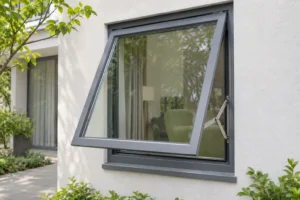
The RGNL-60 Series Aluminum Casement Windows provides the product reference. Its public table identifies a thermal-break awning configuration and lists several opening choices. No verified whole-window U-factor is assigned to RGNL-60 here. Obtain configuration-specific evidence before using a real order in this worksheet.
Verified Product Starting Point
| Published RGNL-60 entry | Separate approval input |
|---|---|
| 60 mm system width | Agreed whole-unit dimensions and review area for each mark. |
| 6063-T5 thermal-break aluminum; 1.6 mm listed thickness | Exact frame, sash and glass configuration associated with the submitted U-factor. |
| Inward, tilt-and-turn, outward and awning modes listed | Selected operation and applicable supporting record, not a family-wide assumed rating. |
Make the Inputs Comparable First
Keep mark, quantity, area per unit, U-factor, units, evidence reference and revision in separate columns. Ask the responsible technical reviewer to confirm the area convention and whether each value applies to the proposed whole window. Glass-only and whole-unit values must not be mixed in one schedule average.
Normalize units before multiplying. The existing U-factor unit comparison addresses that separate step. A supplier’s unexplained number remains unresolved, even when a spreadsheet can calculate with it. Missing evidence is not a zero U-factor; omit neither the unresolved mark nor its area from an otherwise complete-looking result.
Use an Area-Weighted Calculation
The California Energy Commission’s area-weighted worksheet instructions calculate the sum of area multiplied by U-factor, divided by total area. Apply that arithmetic to repeated marks by first extending each mark’s area by quantity:
Schedule U-factor = sum(quantity x area per unit x U-factor) / sum(quantity x area per unit).
Our example uses square metres and W/(m2·K) consistently. This procurement worksheet is not the Commission’s compliance form. Its existence does not establish that averaging is permitted for your project, that different product categories can be combined, or that a manufacturer is certified.
A Hypothetical Two-Mark Order
Every number below is invented for arithmetic only: not a Rogenilan rating, offered size, manufacturing limit, customer project or design requirement. The areas represent hypothetical whole-unit review areas, not visible glass areas.
| Mark and quantity | Area each / extended | Assumed U-factor | Extended area x U |
|---|---|---|---|
| W-01: 8 units | 1.0 m2 / 8.0 m2 | 1.20 | 9.60 W/K |
| W-02: 2 units | 3.0 m2 / 6.0 m2 | 2.00 | 12.00 W/K |
| Schedule total | 14.0 m2 | 21.60 / 14.0 | U-average: approximately 1.543 W/(m2·K) |
The simple average of the two U-factors is 1.60. Weighting only by ten windows gives 1.36. Neither reproduces the area-weighted result because the larger units carry more review area per item. Retain intermediate precision and round the final display; extra decimals do not improve the underlying evidence.
Recalculate After an OEM or ODM Change
If W-01 falls from eight units to four while W-02 stays unchanged, total area becomes 10.0 m2 and the weighted numerator becomes 16.80 W/K. The average becomes 1.68, although neither row’s assumed U-factor changed. A quantity amendment alone can change the schedule result.
For OEM or ODM enquiries, assign responsibility for maintaining the schedule, supplying applicable evidence and approving revised calculations. Recheck quantities, sizes, operation and glass substitutions together. These are buyer requests, not a promise of private-label engineering, testing or design services. Keep the approved baseline and revised return rather than overwriting the earlier decision.
Separate Arithmetic from Technical Acceptance
A reproducible average is only one review result. A low schedule average cannot excuse an individual opening that fails its own requirement. Keep any mark-specific limits and the project reviewer’s decision visible beside the summary.
Check evidence applicability separately for every row. A family name, catalog logo or convenient number is insufficient. For certification questions, use the distinct NFRC listing review; this calculation neither creates nor extends a listing. Do not convert the average into promised energy savings, heating bills or local approval.
Keep Quote Changes Traceable
Request separate confirmation of product revisions, supporting calculations, available documents and any additional assessment cost. A lower calculated average does not show whether glass, hardware, packaging or supply scope changed. Compare price only after the returned configuration and responsibility boundaries are aligned.
Send a Reviewable Schedule
- Marks, quantities, approved dimensions and consistent area convention.
- Exact proposed system, operation, frame and glazing for each row.
- Original U-factor values, full units, evidence and revision references.
- Baseline and revised totals, unresolved entries and named reviewers.
- Project location, mark-specific criteria and defined quotation scope.
Area-Weighted U-Factor Questions
Can I average by window count?
Only equal review areas make count weighting equivalent to area weighting. Otherwise extend each mark’s quantity by its area first.
Does 1.543 describe RGNL-60 performance?
No. It is a hypothetical schedule calculation, not a tested or certified value for any supplied window.
What if one mark has no supported value?
Flag the complete schedule as unresolved for this calculation. Do not insert zero or quietly exclude that mark’s area.
Does the average approve every window?
No. Applicable evidence, individual requirements and project acceptance remain separate decisions for the responsible reviewer.
Request a Traceable Window Return
Send Rogenilan the window marks, quantities, proposed configuration and original thermal requirements. Ask what evidence is available before using any real order in a comparison.